
Choosing greenhouse heating involves more than matching a heater label to the floor area. The useful question is whether the proposed system can maintain the required growing conditions, distribute heat where it is needed and be operated and maintained with the resources available at the site. A good enquiry gives the supplier enough information to explain those choices.
This guide focuses on the information an owner should collect and the questions to ask before purchase. It does not replace a project-specific heat-load assessment or the equipment manufacturer’s installation instructions.
Define the heating requirement before the model
Prepare the greenhouse location, dimensions, covering specification and intended crop temperatures. Note any independently controlled compartments and describe the condition of doors, vents and existing covering. Where information is uncertain, identify it rather than treating a rough estimate as an agreed design input.
The NSW Department of Primary Industries and Regional Development explains that heat demand depends on losses through the greenhouse envelope and air leakage, with the outdoor condition and internal set point affecting the assessment. This is why equal floor areas do not necessarily imply equal heating requirements.
Ask the person preparing the assessment to record the assumptions and the proposed operating conditions. Keep the technical review separate from a sales label such as “suitable for a large greenhouse”. The quotation should identify the particular equipment offered and explain the basis for that selection.
Distinguish heat production from heat distribution
UMass Extension distinguishes the heat source from the means of moving heat around the growing space. Warm-air equipment, air-circulation arrangements and water-based distribution offer different ways to serve a greenhouse. Selecting the source is therefore only one part of the discussion.
Ask for the proposed heater positions, the intended distribution route and the location of the control sensors. Describe the mature crop and any obstacles to access. If the building is to operate in separate zones, ask how the offer addresses those zones and which controls are included.
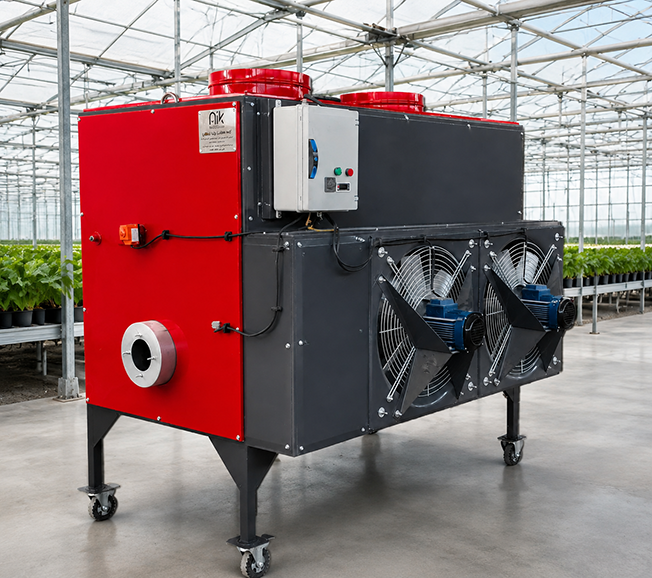
A Nik-Andishan EG 250,000 kcal/h greenhouse heater can be discussed as a specific product enquiry. Confirm what the rating represents, which fuel and electrical arrangements apply to the offered version, and which accessories are included. Do not infer a guaranteed heated area or fuel bill from the model name.
Compare complete operating arrangements
| Question | Information to request |
|---|---|
| What duty is being met? | Recorded greenhouse conditions and the basis of equipment selection |
| How will heat be distributed? | Equipment positions, circulation or distribution arrangement and controls |
| What does the customer provide? | Fuel, electrical connection, site preparation and any work by others |
| How will the system be supported? | Installation instructions, commissioning scope, maintenance and service terms |
When comparing fuel options, record availability and continuity of supply at the actual site. Ask whether the proposed device is compatible with that supply and what installation work is required. Prices and maintenance arrangements should be confirmed for the current offer; an example from another country is not a reliable local operating budget.
Make responsibilities explicit
Heating enquiries can involve the equipment supplier, installer, electrical contractor and other project specialists. Ask who is responsible for each interface and who will confirm that the installation meets the applicable requirements. Combustion equipment needs appropriate professional attention to its fuel, flue and air-supply arrangements.
Before placing the order, request the documents needed for operation and maintenance. Agree the scope of start-up checks and identify how the customer will record an operating problem. Instructions should refer to the supplied model, not simply to a broadly similar heater.
Use records to review performance
Keep a basic operating record once the system is in use: relevant temperature observations, control settings, running periods and maintenance events. Compare like conditions when discussing a change. A warmer week or a different crop schedule can make a fuel comparison misleading if those differences are ignored.
Frequently asked questions
Is a larger heater always the safer purchase? Capacity should be justified by the assessed requirement and the complete arrangement. Ask how the proposed model will be controlled and how heat will reach the required zones.
Can circulation fans replace the heating assessment? No. A circulation arrangement and the required heating output answer different questions. Discuss both as part of the proposed system.
Send your heating enquiry to Nik-Andishan with the location, greenhouse dimensions, covering, intended temperatures and available fuel. For wider project preparation, read our commercial greenhouse planning guide.