
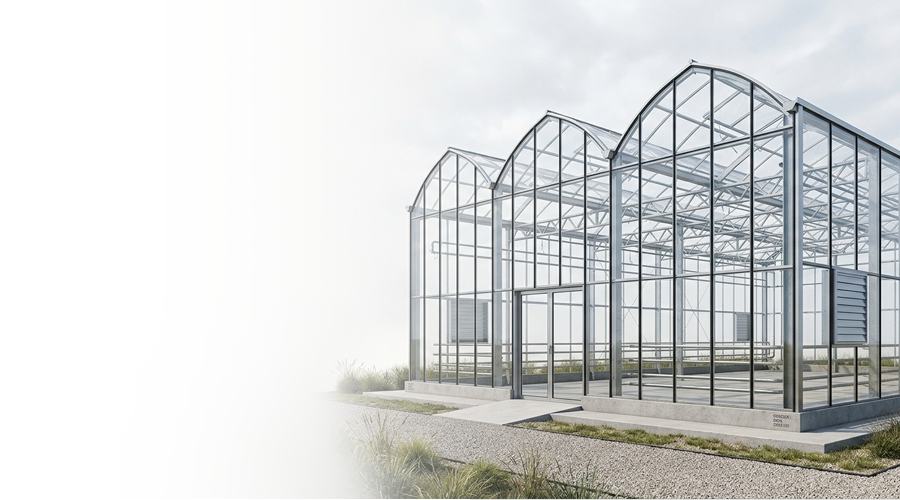
A commercial greenhouse begins with a production brief, not a choice of steel frame. The structure, covering, water supply and climate-control equipment must work together, while the quotation needs to state who is responsible for each part. For an investor, the first useful outcome is a documented set of requirements that different suppliers can understand and price on the same basis.
This guide sets out a practical way to prepare that brief. It applies to a first greenhouse, an extension and a phased development. A larger site adds coordination requirements, but floor area alone does not determine which design is appropriate.
Start with the crop and operating plan
Record the intended crops, production calendar, growing method and handling arrangements. Explain whether different sections need separate operating conditions. These choices help the design team understand the working space, access routes and services to be considered. If the crop plan is still provisional, mark it as an open decision rather than asking suppliers to assume the same answer.
The FAO handbook on greenhouse vegetable production places protected cultivation in the wider context of climate, water and crop management. That systems perspective is useful: buying a structure without considering its operation can leave important requirements unresolved. Recommendations developed for Mediterranean conditions still need to be assessed against the actual project site.
Build a site information pack
Provide the location, surveyed boundaries, access restrictions and available utility information. Include photographs that show the surrounding terrain and the approach for delivery vehicles. Identify which observations are confirmed and which require a specialist survey. A reference climate record is useful background; it does not by itself constitute approval of a structural design.
Obtain an appropriate water analysis and discuss its implications with the relevant crop and irrigation specialists. Ask the project team to identify any treatment, storage or infrastructure requirements that fall outside the greenhouse supply. Keeping these questions visible makes it easier to compare the complete project scope.
Coordinate the structure and the equipment
Request a layout showing growing zones, equipment positions and maintenance access. Heating, ventilation and covering systems should be considered before key dimensions and openings are fixed. The aim at this stage is to identify interfaces and responsibilities, rather than publish a universal set of member sizes or construction details.
For example, a discussion of a Nik-Andishan EG greenhouse heater should include fuel availability, the installation position and the proposed route for distributing heat. A product listing is a starting point for selection, not evidence that one model will suit every building of a given area.
Compare quotations by scope
| Item | What the offer should clarify |
|---|---|
| Structure and covering | Specified materials, included components and drawing responsibilities |
| Equipment | Models, selection assumptions, controls and installation scope |
| Site works and utilities | Included work, exclusions and connections supplied by others |
| Completion | Tests, handover documents, training and the process for recording defects |
Ask suppliers to list exclusions next to their inclusions. An apparently lower price may cover a different package. Record the validity period, payment stages and proposed delivery basis, and ask how changes after approval will be assessed. A comparison is more useful when unresolved items are explicit than when every offer is forced into a single headline price.
Plan expansion before the first phase
For phased developments, distinguish the initial growing area from the eventual site layout. Ask what needs to be reserved for later access, utility routes and additional equipment. A target development area, including a multi-hectare project, should be reviewed through a specific design and execution proposal. It should not be treated as proof of a supplier’s previous experience at that scale.
Agree what completion means
Before signing, define the documents and checks required for handover. The customer should know how to report incomplete work, which operating instructions will be supplied and who will explain the controls. Keep a record of approved changes so that the installed arrangement can be traced to the final project documents.
Questions to settle before requesting a price
Can I request a quotation before all surveys are complete? Yes, but identify the missing information and ask which parts of the estimate remain provisional. Do not compare a preliminary allowance with another supplier’s fully defined scope as if they were equivalent.
Should every project use the same greenhouse type? The selection needs a site and production brief. Request the reasons for the proposed arrangement and its limitations, rather than relying on a generic claim that one type is always best.
Discuss your greenhouse brief with Nik-Andishan. Include the location, intended crop, approximate area, available utilities and proposed development stages.
Technical reading
- FAO: Good Agricultural Practices for Greenhouse Vegetable Crops — Principles for Mediterranean Climate Areas, Plant Production and Protection Paper 217, 2013.